
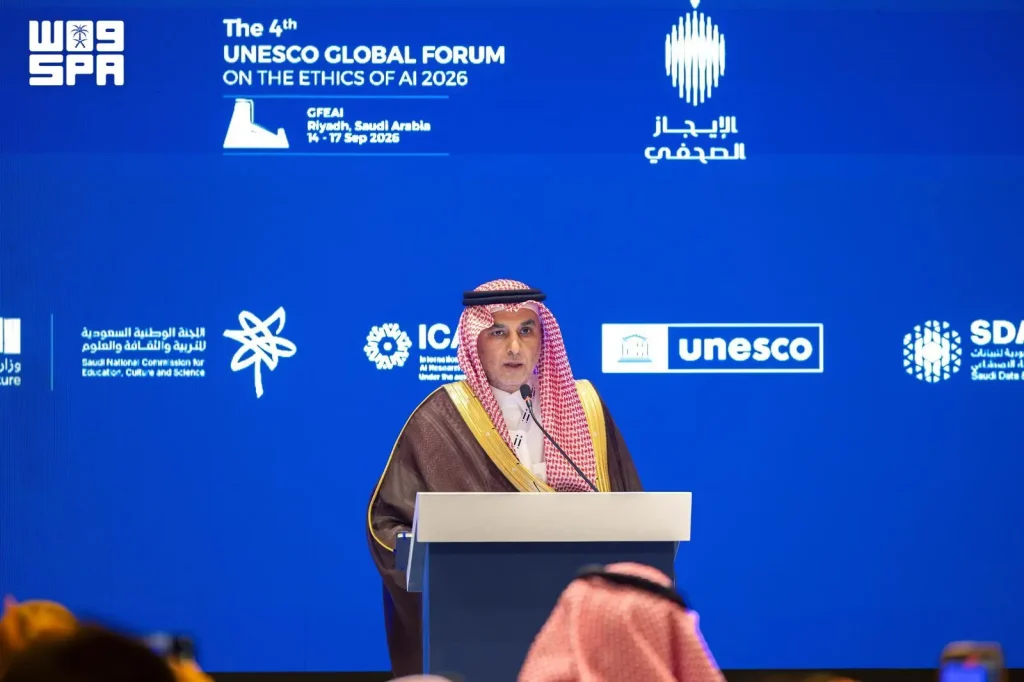
Saudi Arabia's SDIA Chief Highlights AI Adoption and Ethics Forum
The head of the Saudi Center for Data and Artificial Intelligence (SDIA), Dr. Abdullah bin Sheref Al-Ghamdi, emphasized that the Kingdom is committed to adopting artificial intelligence (AI) technologies, balancing innovation acceleration and advanced technological capabilities with responsible governance frameworks to serve humanity. This commitment aligns with the fourth edition of the Global Forum on AI Ethics, which will be hosted in Riyadh from September 14-17, 2026, in collaboration with UNESCO and the International Center for AI Research and Ethics (ICAIRE).
Al-Ghamdi also noted that the Kingdom's hosting of the forum coincides with its designation as the 'Year of AI' in 2026, underscoring its focus on leveraging technology for innovation and development while establishing policies and regulations to ensure responsible and safe use. The Kingdom was among the first to sign UNESCO's AI ethics guidelines and has proposed the establishment of a dedicated international center for AI research and ethics, emphasizing the importance of addressing technological advancements from a human-centric perspective.
SDIA will launch several initiatives in 2026, including over 40 academic programs in data and AI, with more than 1.2 million participants in the national 'Sami' program aimed at training one million Saudis in AI. The 'Sami 2' program will focus on sector-specific training in areas such as energy, healthcare, industry, education, and agriculture, alongside specialized governance initiatives, including frameworks for managing AI risks, responsible technology use policies, and AI badges for individuals.
The forum in Riyadh will feature over 100 speakers across 30 sessions, with over 16,000 registered participants, including the convening of a closed ministerial session with around 60 ministers and heads of delegations. UNESCO's Deputy Director-General, Asa Renier, highlighted the importance of expanding the benefits of AI globally, noting the need for policies that ensure human control and promote principles of responsibility and accountability. She praised Saudi Arabia's hosting of the forum and its role in providing an international platform for dialogue on the future of technology.
The ICAIRE director, Dr. Majid bin Ali Al-Shahri, explained that the methodology for assessing AI ethics readiness has been applied in 78 countries, indicating a gradual shift from theoretical principles to practical applications and policies. ICAIRE is working to build capacity, particularly in developing countries and Africa, and to share knowledge, education, and empower women and youth with the necessary skills, while connecting institutions and experts and transforming successful national experiences into international models.
The forum comes at a time when there is an increasing global need to establish common rules for AI use, balancing the speed of innovation with the protection of human rights and values, and promoting the development of more responsible, inclusive, and human-centered technologies.
