
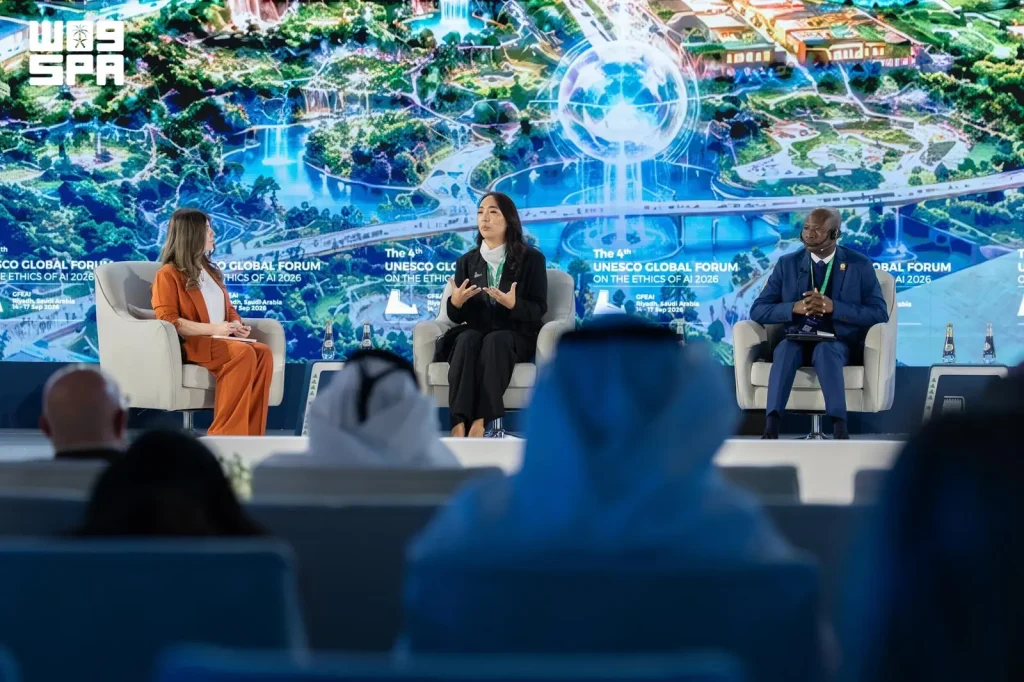
UNESCO Forum in Riyadh Concludes Second Day with Programmes to Train 25,000 Women and 10,000 AI Leaders
The second day of the fourth UNESCO Global Forum on the Ethics of Artificial Intelligence 2026 concluded in Riyadh with international participation from officials, experts, researchers and policymakers. Discussions focused on moving from ethical principles to practical applications in governance, capacity building and the use of AI across sectors.
Sessions held on Wednesday, 16 September 2026 explored countries’ and institutions’ readiness for AI, human-capital development, the future of jobs and skills, as well as safety, the environment, energy, diversity and participation in the governance of emerging technologies.
Saudi Arabia’s Experience in AI Adoption
The forum examined the institutional capacity public administrations need to benefit from AI applications. One session reviewed Saudi Arabia’s experience in expanding AI use across the public sector and the technological, human and institutional readiness required for this phase.
On the future of work, a session organised by the Human Capability Development Program considered AI’s impact on jobs and tasks, drawing on a policy paper developed in partnership with the International Labour Organization.
Discussions addressed the prospect of automating, augmenting or redesigning tasks and the resulting shift in required skills, alongside the role of education, training, qualifications and professional standards in responding to new labour-market needs.
Governance, Safety and Sustainability
A session organised by the Saudi Data and Artificial Intelligence Authority (SDAIA) examined how to strengthen women’s participation in shaping AI-governance frameworks and turn a gender perspective into practical action.
Another session explored the relationship between AI safety and AI ethics, while specialised sessions addressed the use of intelligent technologies in the environment, ecosystems and energy, and their potential contribution to sustainability.
International cooperation featured prominently, including discussion of the Global Network of AI Supervisory Authorities (GNAIS), its role in coordination, knowledge exchange and more effective oversight of AI use. Saudi Arabia, represented by SDAIA, co-chairs the network.
Honouring 52 Data and AI Specialists
In the area of talent development, SDAIA honoured 52 experts and specialists who earned professional badges in data and AI, in the presence of the Authority’s Vice President, Engineer Sami bin Abdullah Muqeem.
The badges are based on assessments and professional standards measuring knowledge, competence and applied experience. They are offered through the Data Scientist and AI Engineer pathways, each with three levels: Associate, Professional and Expert.
Among the day’s key announcements was the launch of the third edition of Elevate, a programme that aims to empower 25,000 women worldwide in AI ethics, supporting skills development and greater women’s participation in the field.
In a second international initiative, ICAIRE announced a programme to train 10,000 AI leaders over two years in partnership with the Islamic World Educational, Scientific and Cultural Organization (ICESCO), the Apolitical platform, and the Saudi National Commission for Education, Culture and Science.
The programme targets senior public-sector leaders and decision-makers and is set to expand progressively to ICESCO’s 53 member states. Delivered entirely online, it offers four tracks covering AI fundamentals, advanced applications, ethics and governance, and AI for strategic decision-making.
The second day concluded with a discussion on the role of UNESCO centres and partner institutions in turning AI-ethics recommendations into implementable policies and practices. The four-day forum concludes in Riyadh on Thursday, 17 September 2026, following sessions, initiatives and international dialogue on building a more responsible and secure AI-governance ecosystem.
