
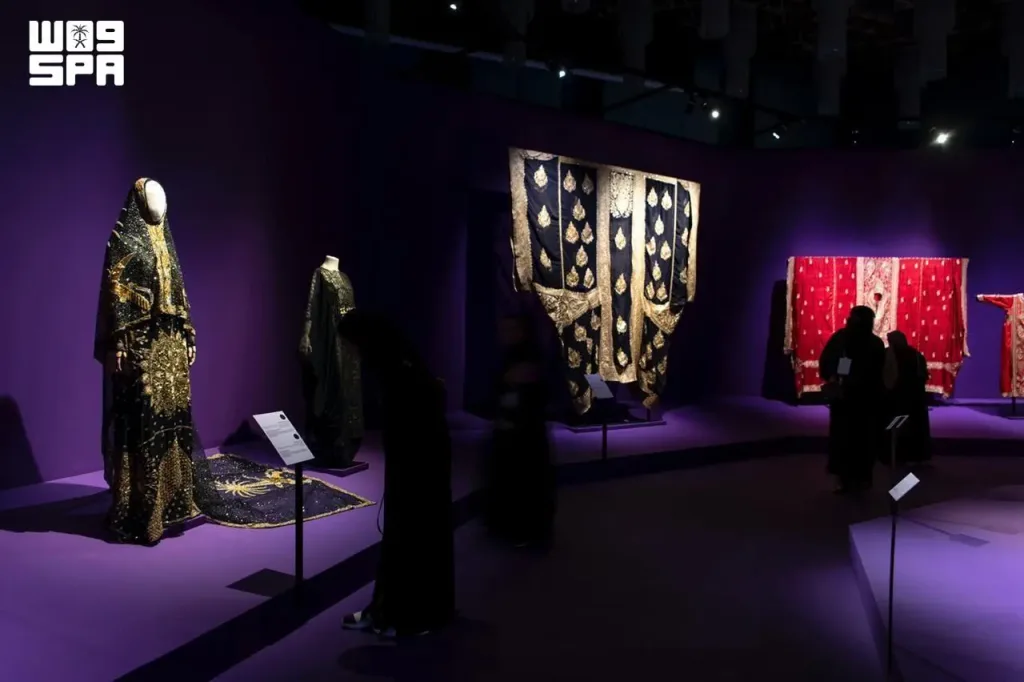
Traditional Saudi Women’s Clothing Reflects the Kingdom’s Cultural Identity Through Color and Embroidery
Traditional women’s clothing in Saudi Arabia represents a rich visual record of the Kingdom’s cultural heritage, with its fabrics, colors, embroidery, and designs reflecting the distinctive traditions and environments of different regions.
Highlighted on the occasion of Saudi National Day, these garments reveal how clothing has long been connected to everyday life, weddings, celebrations, and social customs, while preserving skills and craftsmanship passed down through generations.
Central Saudi Arabia: Diverse Dresses and Decorative Styles
Central Saudi Arabia is known for several traditional women’s garments, including the “Munaykhil,” distinguished by its loose design and wide sleeves, and the “Mushallal,” a lightweight and decorated garment traditionally worn over another dress.
The Dara’ah was also common in central and northern parts of the Kingdom and appeared in numerous styles featuring different fabrics and decorative techniques.
Makkah and Madinah: Embroidery and Special-Occasion Clothing
In the Makkah Region, traditional women’s clothing reflected different lifestyles, social occasions, and celebrations, with embroidery playing a prominent role in garment decoration.
Traditional fabrics included “Dout,” featuring multicolored patterns and silk decorations, as well as the red “Qarqush” fabric with black decorative elements.
Madinah, meanwhile, became known for the “Kurtah,” a long-sleeved dress extending from the neck to the feet and produced in various colors and fabrics.
Traditional bridal clothing also included the “Shar’ah Madini,” a dark pink garment decorated with golden threads.
Eastern Province: Long, Flowing and Decorative Garments
Traditional women’s clothing in the Eastern Province was generally characterized by long and flowing designs, with clear differences between everyday garments and more elaborate clothing worn for special occasions.
Notable garments included the Dara’ah, Hashemi dress, Masrah, Manthur, and Thuraya dress, with silk and golden threads used in some decorative styles.
Northern Saudi Arabia: Clothing Shaped by Local Environments
Across Hail, Al-Jouf, the Northern Borders, and Tabuk, traditional clothing reflected the characteristics of local communities and environments.
Among the distinctive garments was the “Murawdan,” a full-length dress featuring long triangular sleeves.
In Al-Jouf, silk, cotton, wool, beads, and metal decorations were incorporated into garments such as the “Muhawthal,” “Sharsh” or “Madaqqah,” and “Zabun.”
Traditional clothing in Tabuk included long dresses, buttoned upper garments, and trousers, while the Northern Borders Region was known for garments including the “Maqta,” “Masrah,” and “Kurtah.”
Southern Saudi Arabia: Gold and Silver Embroidery
Southern Saudi Arabia also developed distinctive clothing traditions.
In Asir, women’s garments were widely decorated with gold and silver threads. One of the best-known traditional dresses was the “Muzannad,” historically made from black silk and richly embellished with gold and silver embroidery.
In Al-Baha, the “Mishal” dress was traditionally reserved for celebrations, weddings, and Eid occasions, while Jazan was known for hand-embroidered versions of the Kurtah, alongside colorful clothing for younger girls.
In Najran, the “Mukammam” became one of the region’s distinctive traditional garments, featuring a long black design with wide sleeves and decorations around the waist and chest.
Clothing as a Record of Craftsmanship and Identity
Beyond their visual appearance, Saudi women’s traditional garments preserve generations of knowledge in fabric selection, color coordination, sewing, embroidery, and decoration.
Silk, cotton, wool, gold and silver threads, beads, and decorative materials were combined in different ways across the Kingdom, allowing each garment to reflect its local environment, social function, and cultural heritage.
Together, these traditional styles form an important part of Saudi Arabia’s cultural memory and demonstrate the diversity that exists within the Kingdom’s broader national identity