Taibah University Concludes MCAIT 2026 with AI Research Findings Reaching 98.29% F1 Score
Madinah, Saudi Arabia – November 6, 2026
Taibah University has concluded the sixth International Conference on Artificial Intelligence and Its Technologies (MCAIT 2026) in Madinah, following three days of scientific presentations, specialized workshops, and research sessions exploring advances in artificial intelligence.
The conference's final day featured studies on Arabic language models, visual speech recognition, healthcare applications, historical manuscript digitization, and the reliability of AI-generated legal information.
Discussions also covered AI applications in education, cybersecurity, and smart cities.
Evaluating the Reliability of Arabic Language Models
Researcher Reem Al-Tamimi presented an analysis of 17 scientific studies examining how AI models process Modern Standard Arabic and regional dialects.
The findings revealed differences in the models' ability to interpret dialects while preserving meaning and cultural context.
The research proposed a framework for developing more comprehensive evaluation standards for Arabic language models.
Lip-Reading AI Model Achieves 87.02% Accuracy
Taibah University researchers presented a deep-learning model designed to recognize spoken Arabic words by analyzing lip movements without audio input.
The experiment focused on four words: “yes,” “no,” “sorry,” and “thank you.”
The model achieved 87.02% accuracy in recognizing the four Arabic words, while accuracy reached 78.01% when an additional category was introduced for unknown words.
The results demonstrate research progress in visual speech recognition technologies.
Medical AI Study Analyzes 170,000 Arabic Questions
In healthcare research, Enas Al-Ruhaili and Areej Al-Hudhali presented a study classifying approximately 170,000 Arabic medical questions into three risk levels.
The AraBERT model achieved an F1 score of 98.29%, compared with 95.59% for a convolutional neural network (CNN).
The findings indicate potential for AI-assisted systems that classify medical inquiries and support prioritization, subject to further validation before real-world clinical deployment.
AI Research Supports Arabic Manuscript Digitization
Researcher Bashayir Al-Saidlani presented a comparative study of Arabic optical character recognition technologies using 500 lines from historical manuscripts.
The analysis found substantial differences in character error rates, with one system recording 27.92% compared with 43.66% for another.
A separate experiment involving automatic Arabic diacritic restoration achieved an error rate of 4.06%.
These findings provide useful evidence for selecting technologies to digitize and preserve Arabic historical texts.
Testing AI Consistency in Legal Applications
Researchers Noura Al-Rajeh and Mayada Al-Masri examined the consistency of three language models when responding to legal questions in Arabic and English.
The study used 90 legal questions concerning Saudi Arabia's Personal Data Protection Law and the European Union's General Data Protection Regulation (GDPR).
Across 254 pairs of responses, the models demonstrated 87% consistency.
The findings highlight the importance of evaluating multilingual AI systems for reliability and consistency in legal information tasks.
Research Sessions and International Collaboration
The conference's third day included parallel research sessions delivered both in person and online, as well as a specialized workshop.
Participants discussed emerging AI technologies and their applications across multiple sectors, with particular attention to model accuracy, reliability, and practical implementation.
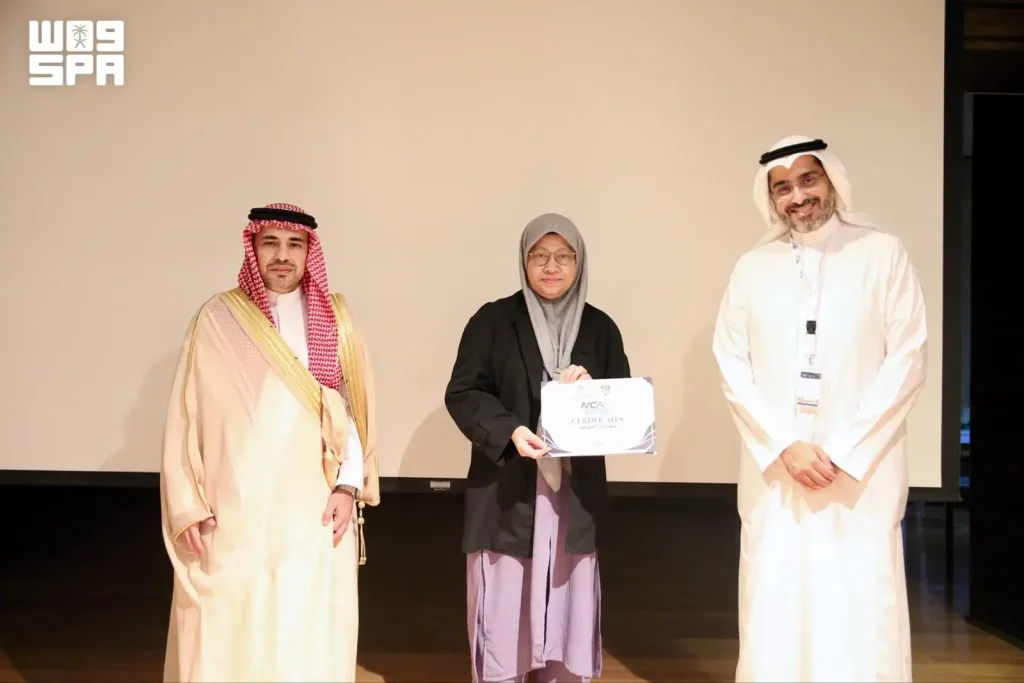
At the closing ceremony, Taibah University expressed appreciation to the National University of Malaysia for its scientific partnership in organizing the event.
The university also honored the teams responsible for supporting the conference's organization and activities.
MCAIT 2026 highlighted the growing diversity of AI research, spanning Arabic language technologies, healthcare, law, cultural heritage, and other fields of practical application.