
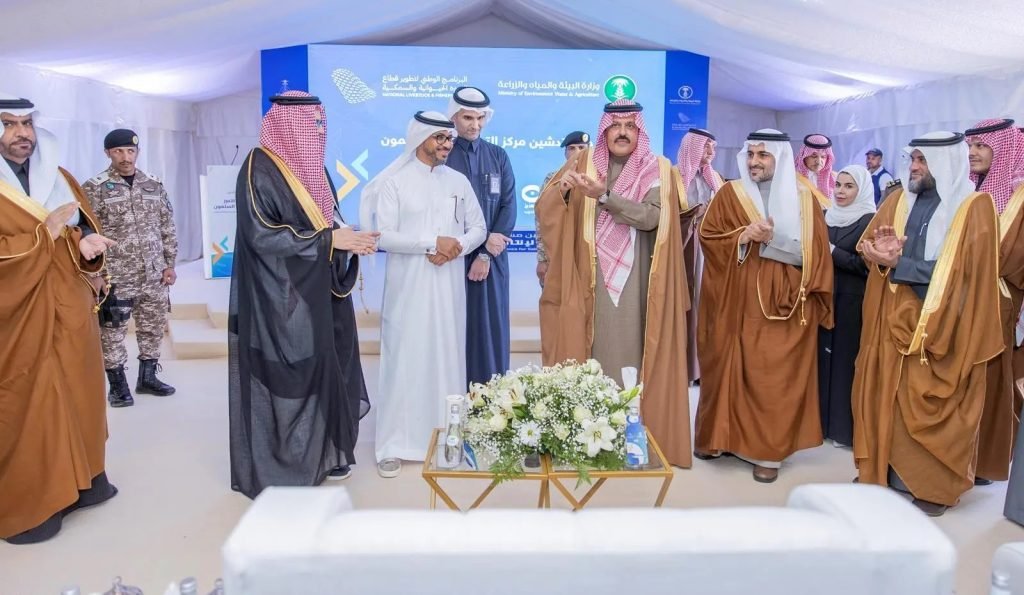
Emir of Hail Region Launches Salmon Production Center of Excellence, a Model for Sustainable Development and Food Security
HRH Prince Abdulaziz bin Saud bin Abdulaziz, Emir of Hail region, today inaugurated the Salmon Production Center of Excellence, one of the flagship projects run by the Ministry of Environment, Water and Agriculture under the "National Program for the Development of the Livestock and Fisheries Sector." The launch was attended by Deputy Minister of Environment, Water and Agriculture Engineer Mansour Al-Mushaiti, King Abdulaziz University President Dr. Tarif Al-A'ma, and a number of local and international officials and experts.
Project Highlights:
The Salmon Production Center of Excellence is located in the Al-Qaed area of Hail and covers 10,000 square meters, of which 4,352 square meters are dedicated to hatchery and fish-farm facilities and an aquaponics unit. The project marks a strategic step toward establishing a sustainable food-production hub in the region.
The project aims to:
- Strengthen food security: reducing reliance on imports, which currently total 23,000 tonnes of salmon a year.
- Increase local production: with a total production capacity of up to 100,000 tonnes annually.
- Support innovation and technology: through advanced closed-loop water recirculation systems that improve operational efficiency.
- Develop national talent: training local expertise in aquaculture and fish farming.
- Achieve sustainability: through aquaponics and highly efficient resource recycling.
Officials' Remarks:
- The Emir of Hail region stressed the project's importance as a valuable addition supporting Saudi Vision 2030's goals for food security and sustainable development, praising the efforts of all parties involved in achieving it.
- Engineer Mansour Al-Mushaiti noted that the project reflects the aspirations of the Kingdom's leadership, under the Custodian of the Two Holy Mosques and the Crown Prince – may God protect them – to achieve leadership in the fisheries sector.
- Dr. Fahd bin Muayyad Al-Hosni, the ministry's regional director-general, said the project embodies Hail region's ambition to become a model for sustainable development.
Project Components:
- Broodstock, hatching and incubation unit.
- Larval rearing and grow-out units.
- Closed-loop water recirculation systems.
- An aquaponics unit.
- Laboratories and logistical support facilities.
Project Impact:
- Lower local production costs for salmon.
- Job opportunities for national talent.
- Increased local production of fruit-bearing plants and vegetables.