
King Khalid University Launches Forum on Developing Arabic Language Teaching for Non-Native Speakers
Abha, 21 April 2025 (23 Shawwal 1446H)
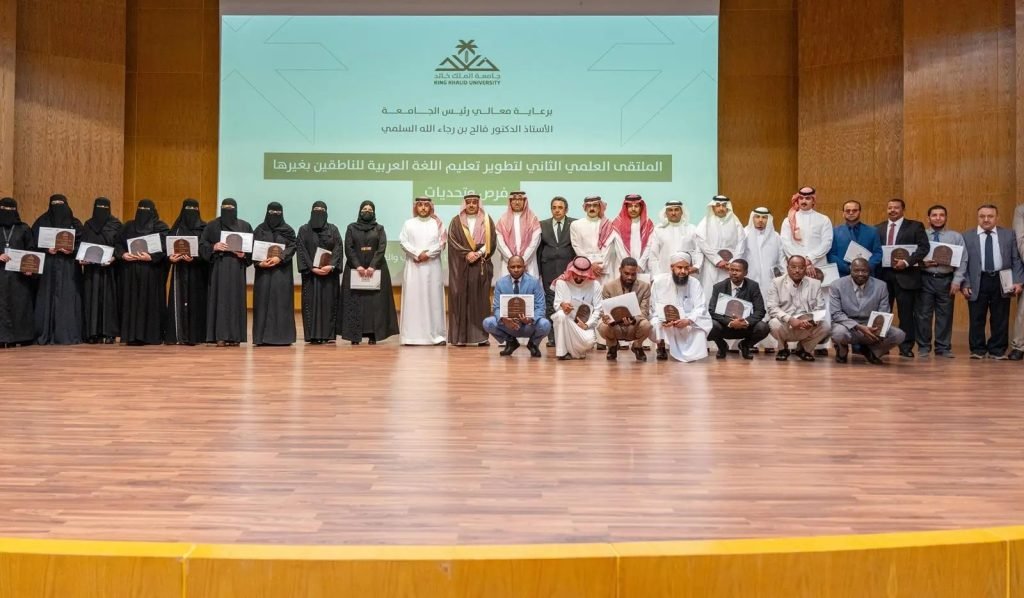
King Khalid University, represented by its College of Arts and Humanities, organized the second scientific forum on developing the teaching of Arabic to non-native speakers, titled "Developing Arabic Language Teaching for Non-Native Speakers: Opportunities and Challenges," held at the Exhibitions and Conferences Center on the university campus. The forum was attended by university president Dr. Faleh bin Rajallah Al-Salmi, along with a select group of academics and specialized researchers.
The forum aims to stimulate scientific research in the field of teaching Arabic as a second language by evaluating current methods and curricula, and exploring new development opportunities through digital technologies and artificial intelligence, and building curricula that account for learners' diverse cultural and linguistic backgrounds.
24 Researchers from 7 Colleges and Centers
The forum brought together 24 researchers representing 9 academic departments from 7 colleges and centers at the university, with proceedings spread across three main scientific sessions that discussed the challenges and opportunities in teaching Arabic to non-native speakers, alongside new academic insights and practical proposals for improving educational and pedagogical performance in this field.
Technology and Education Face to Face
- The first session, "Employing Artificial Intelligence and E-Learning in Teaching Arabic to Non-Native Speakers," was chaired by Dr. Adel Asiri.
- The second session addressed "Modern Curricula and Strategies," chaired by Dr. Ahmed Al-Masoudi.
- The forum concluded with a third session titled "Developing Teachers' Skills and Educational Competencies," chaired by Dr. Yasser Al Mad'ath.
A Global Educational Vision with an Arab Spirit
Participants stressed the importance of developing curricula and integrating modern strategies in teaching Arabic to non-native speakers, describing it as an important cultural bridge that promotes global understanding and carries the Kingdom's message of spreading its language and culture as part of Saudi Vision 2030.