
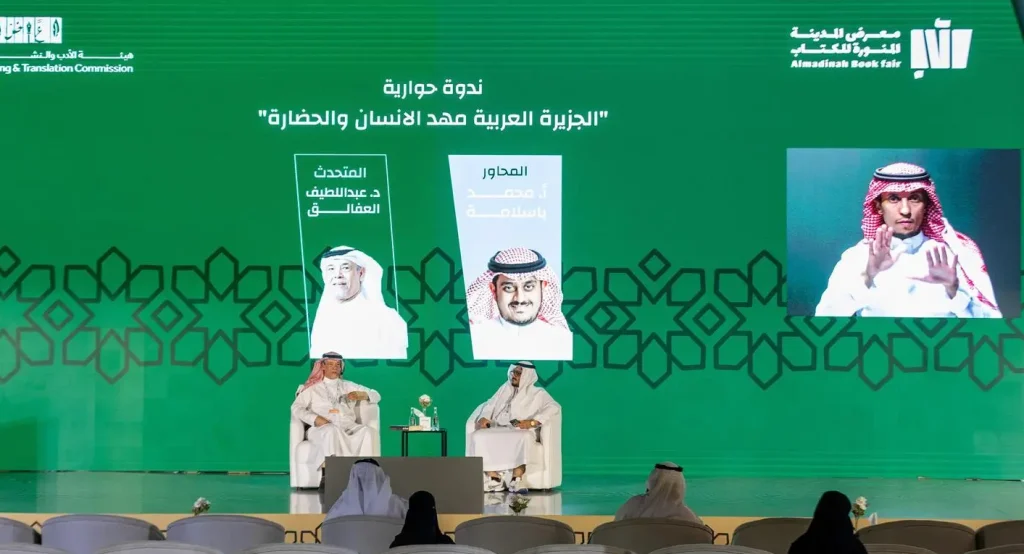
Symposium at Madinah Book Fair 2025: The Arabian Peninsula, Cradle of Humanity and Origin of Civilization
Madinah | 11 Safar 1447H, corresponding to 5 August 2025. As part of Madinah Book Fair 2025, a notable scientific symposium titled "The Arabian Peninsula: Cradle of Humanity and Civilization" drew a large audience of people interested in history, archaeology and anthropology. The symposium was moderated by broadcaster Mohammed Baslamah and featured researcher Dr. Abdullatif Al-Affaleq, a specialist in comprehensive history, who presented a comprehensive scientific view built on the hypothesis that the Arabian Peninsula was not merely a corridor for human migrations but an original homeland for the emergence of modern humans.
Al-Affaleq affirmed that recent discoveries in fossils, inscriptions and stone tools, alongside climatic and geological studies, all indicate that the Arabian Peninsula was a suitable environment for human life since the dawn of history, possessing the conditions for human settlement, from petrified forests to water resources and integrated ecosystems.
Al-Affaleq presented his thesis, documented in his recently published book "Roots" ("Juthur"), which puts forward a new scientific argument that reshapes traditional hypotheses about the origin of humankind and provides strong evidence placing the Arabian Peninsula at the heart of the global debate over the first cradle of humanity, moving beyond the prevailing Western theories that confined humanity's earliest origins to other parts of the ancient world.
He also stressed that an integrated analysis of the scientific data, in light of religious texts, strengthens the hypothesis that the Arabian Peninsula was a cradle of human civilization, reflecting the deep relationship between people and place throughout history.
The symposium opened a wide-ranging discussion on the civilizational identity of the Arabian Peninsula and the importance of reconsidering the region's geographic position within the global scientific context, enhancing the value of the Kingdom's civilizational and cultural heritage and aligning with Vision 2030's goal of cementing civilizational depth as one of its core pillars.