
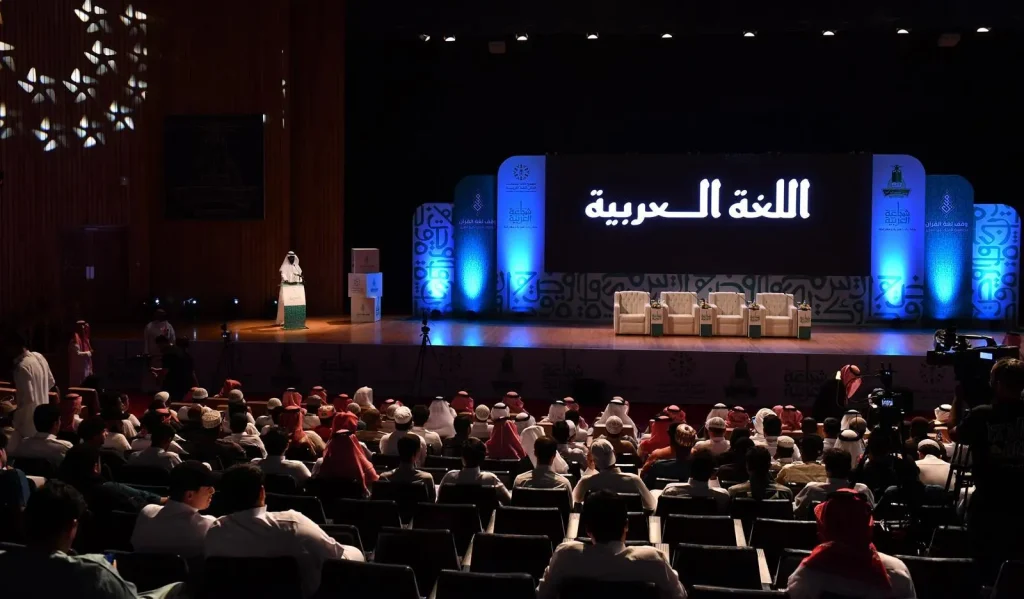
King Abdulaziz University Launches International Symposium on the "Courage of Arabic"
At a Glance
- Location: Jeddah
- Date: 22 Rabi' al-Thani 1447H, corresponding to October 14, 2025
- Venue: King Faisal Conference Hall
- Organizers: Quran Language Endowment, in cooperation with King Salman Global Academy for Arabic Language
Under the patronage of His Royal Highness Prince Khalid Al-Faisal bin Abdulaziz, advisor to the Custodian of the Two Holy Mosques, Emir of Makkah region and honorary president of the Quran Language Endowment, King Abdulaziz University today opened the international symposium "Courage of Arabic: Linguistic and Cognitive Approaches." Organized by the Quran Language Endowment in cooperation with the King Salman Global Academy for Arabic Language, the symposium is being held at the King Faisal Conference Hall with the participation of a host of scholars, thinkers and researchers from inside and outside the Kingdom.
The opening ceremony began with remarks from KAU President and Chairman of the Quran Language Endowment's Board of Trustees, Dr. Tarif bin Yousef Al-A'ma, who said the symposium reflects the Kingdom's dedication to Arabic as a language of cognitive and civilizational identity, and as a tool for founding thought, creativity and human awareness. He noted that Arabic possesses strength, renewal and the capacity to engage with the modern era, describing it as a language that "carries the courage to confront and to influence" — not merely a means of communication, but a vessel of thought, history and humanity.
Al-A'ma explained that the symposium aims to offer an in-depth scholarly reading of the concept of the "courage of Arabic" through specialized themes examining the language's ability to adapt to contemporary linguistic shifts and embrace digital education and modern technology, as well as its capacity to meet the demands of Arabization, translation and artificial intelligence technologies — all of which strengthen its global presence in line with Saudi Vision 2030's knowledge-development goals.
The ceremony included a visual presentation showcasing the Quran Language Endowment's projects and programs, followed by a poetry recitation by Dr. Mohammed Ali Al-Amri celebrating the Arabic language's status and rhetorical richness.
Secretary-General of the King Salman Global Academy for Arabic Language Dr. Abdullah bin Saleh Al-Washmi then delivered remarks affirming that the cooperation with King Abdulaziz University falls within the Academy's efforts to advance initiatives serving the Arabic language and support its presence in education, scientific research, technology and innovation. He noted that the Academy has in recent years launched a series of flagship programs, including building massive linguistic corpora, developing advanced digital platforms, issuing specialized dictionaries, and forging national partnerships to empower and institutionalize the use of Arabic.
The symposium featured scholarly panel discussions; the opening session addressed "The Importance of Arabic and Ways to Advance It," with the participation of several ministers and intellectual and scientific figures, most notably Sheikh Dr. Saleh bin Abdullah bin Humaid, Imam and preacher of the Grand Mosque and member of the Council of Senior Scholars; former Minister of Information Dr. Abdulaziz Khoja; and Dr. Abdulaziz Al-Sebail, former Secretary-General of the King Faisal International Prize, alongside a group of researchers and specialists.
The second session, titled "A Reading in Building the Concept and Its Dimensions," examined the methodologies for studying the concept of the "courage of Arabic" and its cognitive and linguistic dimensions, framing it as a call to renew linguistic and intellectual awareness in light of contemporary changes.
The opening ceremony concluded with the honoring of participating organizations and speakers, amid participants' emphasis on the importance of supporting national initiatives dedicated to serving and empowering the Arabic language globally, and strengthening its presence in the era of digital transformation.
The symposium continues tomorrow with a number of scientific sessions and accompanying events addressing issues facing the Arabic language in civilizational, educational and technical contexts, with the participation of experts and researchers from across the Arab world and beyond.