
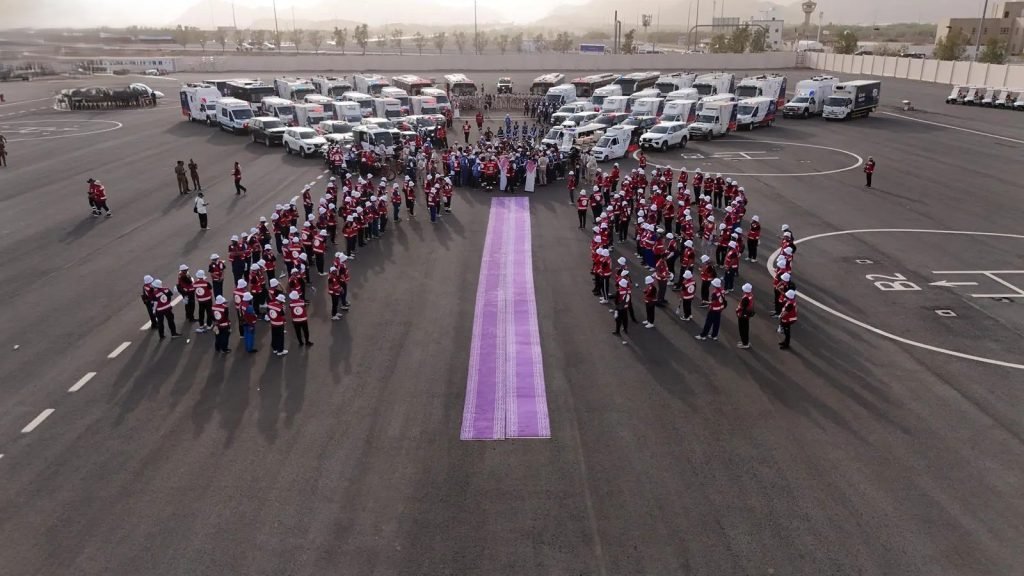
Saudi Red Crescent Raises Its Emergency Readiness for Hajj 1447 with More Than 900 Vehicles and 2,771 Field Staff
The Saudi Red Crescent Authority is continuing to implement its operational plan for the Hajj season of 1447 AH, within an integrated national health system aimed at strengthening emergency readiness and raising response efficiency at the holy sites and the roads leading to them, ensuring advanced emergency services for the Guests of God throughout their spiritual journey.
The authority said its operational plan includes a wide field deployment that begins when pilgrims arrive at the Kingdom's ports and continues through every stage of their movement between Makkah and the holy sites.
More Than 526 Ambulance Points to Serve Pilgrims
Dr. Taimur Jan, official spokesperson for the Saudi Red Crescent Authority, said the plan operates 526 ambulance dispatch points distributed according to density and movement monitoring across the holy capital, the Grand Mosque and the holy sites.
The distribution includes 70 ambulance points in the holy capital, 75 inside the Grand Mosque, 178 in Mina and 203 in Arafat and Muzdalifah, speeding up access to cases and raising the efficiency of field response.
A Varied Fleet of More Than 900 Emergency Vehicles
The authority has deployed an integrated field fleet of more than 900 emergency vehicles of various types, including 305 ambulances equipped for advanced care and the transport of critical cases, along with 20 "Obaya" rapid intervention vehicles to support early access to cases.
The system also includes 119 golf carts for movement inside high-density corridors and camps, 23 motorcycles for rapid access in crowded locations and 155 emergency scooters to support flexible movement within the holy sites.
The equipment also includes 200 "Rufaida" electric emergency chairs, 80 bicycles for field monitoring and 7 air ambulances within the aerial support system for critical cases.
Advanced Readiness for Major Incidents
The spokesperson said the operational plan also includes nine specialized advanced vehicles dedicated to major incidents and multiple casualties, under approved response plans aimed at raising the efficiency of handling emergency reports during the season.
The authority also relies on command and control rooms that continuously monitor field indicators and support the distribution of resources and field readiness, ensuring rapid response and efficient service delivery.
"Rufaida" Inside the Grand Mosque
The authority confirmed the use of special emergency means inside the Grand Mosque suited to the nature of the site and its high density, most notably "Rufaida", an electric emergency vehicle that allows rapid access to cases in crowded pathways and the delivery of direct emergency care.
These solutions are part of the authority's drive to draw on modern technology and smart mobility to serve the Guests of God with high efficiency.
More Than 2,771 Staff and Health Volunteers
The operational plan relies on more than 2,771 emergency staff and health volunteers, including 1,771 specialized emergency and operational staff and 1,000 qualified health volunteers.
The specialized staff include 42 medical control physicians, 1,533 emergency service providers and 196 medical evacuation specialists, working within a unified system to support rapid response and quality of service for pilgrims.
Integration with the Private Sector to Strengthen Response
Dr. Taimur Jan noted the participation of private sector teams in the operational plan, operating 264 ambulance units and 725 foot emergency units in support of the emergency response system at the holy sites.
This is part of integrated efforts to raise readiness and strengthen the efficiency of health and emergency services during the Hajj season.
At a Glance
- Location: the holy sites, Makkah
- Body: Saudi Red Crescent Authority
- Ambulance points: 526
- Emergency vehicles: more than 900
- Staff and volunteers: 2,771