
King Fahd National Library Hosts Session on Ancient Arabian Inscriptions with Professor Sulaiman Al-Theeb
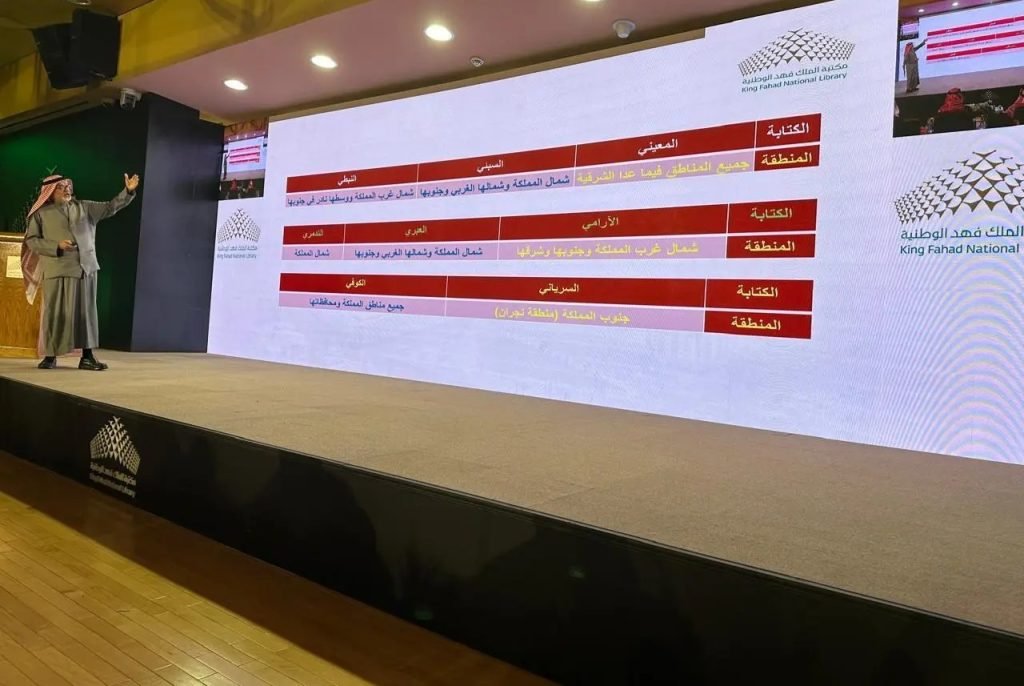
King Fahd National Library held a dialogue session on Tuesday evening titled "Ancient Arabic Writings on the Arabian Peninsula," presented by Professor Sulaiman bin Abdulrahman Al-Theeb, a former professor of ancient inscriptions at King Saud University and one of the leading specialists in the study of ancient scripts and inscriptions.
Tracing the Roots of Writing
During the session, Professor Al-Theeb reviewed several key themes, spotlighting the origins of writing worldwide and its stages of development throughout history, as well as the various ancient scripts that appeared on the Arabian Peninsula before the emergence of Arabic script, including:
- Thamudic
- Lihyanite
- Safaitic
- Aramaic
- Nabataean
- South Arabian (Musnad)
Al-Theeb explained that the ancient inscriptions of the Arabian Peninsula form an important part of the history of human civilizations, noting that the Thamudic inscriptions found across many regions of the Kingdom are among the oldest known scripts. They were named for the frequent recurrence of the letters "h-th-m-d" within them, and have no connection to the Thamud people mentioned in the Quran.
Theories on the Origin and Evolution of Language
The professor addressed the various theories on the origin and development of language, explaining that they fall into four main categories:
- The theological theory: holds that language is a divine inspiration bestowed upon humankind.
- The philosophical theory: holds that language emerged from humans improvising words.
- The biological theory: traces the origin of language to the evolution of movements and sounds produced by human and animal emotional reactions.
- The anthropological theory: links sounds and meanings gradually over time.
Al-Theeb also outlined the stages writing passed through, beginning with primitive drawings, moving through symbolic and syllabic writing, and culminating in alphabetic writing, an advanced stage in the history of writing systems.
Professor Al-Theeb's Contributions
Professor Sulaiman Al-Theeb is regarded as one of the foremost specialists in ancient inscriptions and scripts, with numerous research contributions and publications considered key references in the study of Arabian inscriptions. His most notable works include:
- An Analytical Study of the Ancient Aramaic Inscriptions of Tayma
- Nabataean Inscriptions of Al-Hijr
- The Nabataean Lexicon
- Grammar of the Nabataean Language
- Social Life in the Hail Region Through Thamudic Inscriptions
- Ancient Arabic and Islamic Inscriptions from the Najran Region
Why the Session Matters
The session is part of King Fahd National Library's efforts to raise cultural and historical awareness and deepen interest in the heritage and long history of the Arabian Peninsula. It also helps highlight the importance of ancient inscriptions in understanding the history of the peoples and civilizations that flourished on the Arabian Peninsula before Islam.