
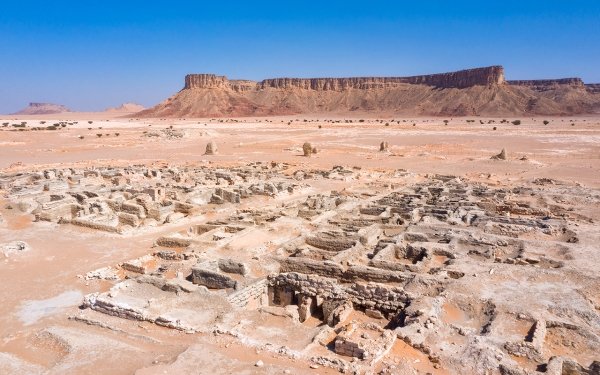
Al-Faw: The Ancient Village That Once Ruled the Kindah Kingdom
Overview
The archaeological village of Al-Faw lies 700 kilometers southwest of Riyadh and is considered one of the most important archaeological sites on the Arabian Peninsula. The village sits alongside the Tuwaiq Mountains and intersects with Wadi Al-Dawasir, overlooking the western edge of the Empty Quarter sands, giving it a strategic location just 150 kilometers from the Wadi Al-Dawasir governorate.
Historical Significance
In ancient times, Al-Faw served as the capital of the Kindah Kingdom, playing an important role in the history of the Arabian Peninsula for more than five centuries. The village became a major trading center on the incense trade route between southern Arabia and Mesopotamia, and was known as “Qaryat Dhat Kahl.” It also lay along the ancient Silk Road path known as the Najran Route.
Archaeological Remains
Al-Faw is distinguished by a diverse array of archaeological features, including markets, roads, cemeteries, temples, water wells and residential houses. Among the notable artifacts discovered there is a gilded bronze bed-head sculpture dating back to the third century BC, and a limestone incense burner dating to the sixth century BC. The village also contains a large number of ancient Arabic inscriptions that reveal the ways of life, trade and religion of that era.
Historical Cemeteries
Al-Faw contains three types of cemeteries reflecting the social and political diversity of its inhabitants:
- Family and communal cemeteries: belonging to families and figures of political and social standing.
- Noble tombs: consisting of two chambers, eastern and western, with a descent for easier access.
- Public cemeteries: for ordinary people, located northeast of the city.
Recent Archaeological Discoveries
On 27 Dhul Hijjah 1443 AH, corresponding to 26 July 2022, the Heritage Commission announced new archaeological discoveries at Al-Faw, including an area used for religious rites on the outskirts of the Tuwaiq Mountains, remains of human settlements dating back 8,000 years to the Neolithic era, and the documentation and classification of more than 2,807 tombs.
Al-Faw’s Path to UNESCO Recognition
Saudi Arabia is seeking to register Al-Faw village on the UNESCO World Heritage List, alongside three other archaeological villages in the Kingdom.
More Information
For further details, visit Al-Faw archaeological village on Saudipedia.